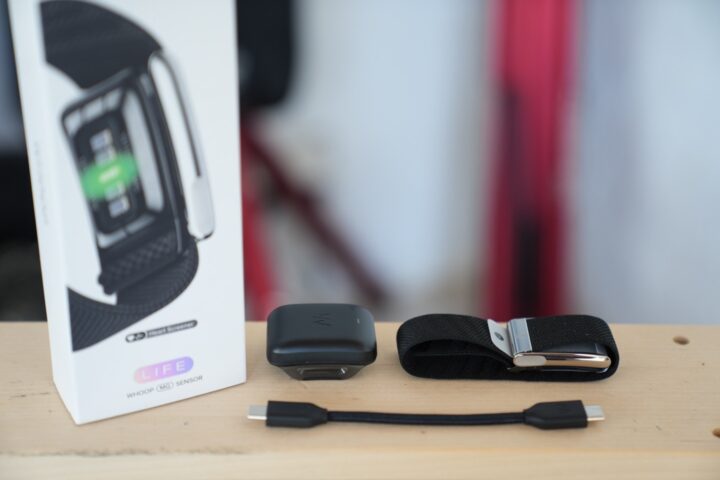
It didn’t take long for Whoop to respond to Google-Fitbit’s announcement of the Fitbit Air. By the next morning, the company had posted a seemingly hastily written post on Reddit announcing a slate of vaguely worded plans. Hours later, the CEO would post a vertical video to social media that roughly reiterated those plans. He’d also post a passive-aggressive post to X/Twitter. Then by Sunday, the company had finally sent something a bit more formal to users, albeit with far fewer features noted than the other posts.
The Fitbit Air has unquestionably put Whoop quickly on the defensive. While there have been a number of screen-less wearables announced over the past year, including most notably the Amazfit Helio Band ($99) and Polar Loop ($199), neither has had the financial engine behind them like Google does. In the case of Amazfit, which made a super compelling budget option, manufacturing couldn’t keep up with demand (and still can’t), and the company had but a fraction of a fraction of the marketing share of Whoop. Meanwhile, for Polar, Whoop was clearly nervous about that one and decided to sue Polar for trade dress allegations (basically, saying Polar infringed on Whoop’s looks).
Still, the Fitbit Air hits different. Priced at $99, with stylish band options that Amazfit & Polar mostly lacked, and backed by a company with massive manufacturing and global marketing power, it’s a real threat to Whoop. But more critical than the hardware price, is that it doesn’t require a subscription (which starts at $200/year for Whoop and goes upwards to $359/year). Sure, Google’s offering is more aligned to Whoop’s when you include that Google’s Premium subscription, but even that is only half the price of Whoop’s subscription, at $99 year (or $79/year for existing subscribers). Beyond that, Google is leading their messaging that this is more of an open platform, eager to pull in data from all your data sources (whereas Whoop has long been very closed, save for a few partners they export data to, usually with an API licensing fee).
All of which seemingly led to the below Reddit post.
The Reddit Post

By the morning following Fitbit’s announcment, Whoop had published the below post to Reddit, via their official/verified account. As I started reading through this for the first time, I couldn’t help but think it seemed written by someone that had just cheated on their partner, and was rambling on about all the ways they’d change. While it has some specific items in there, most of it is pretty thin on actual details/dates. It lacks any of the formality and concreteness you’d see in typical Whoop communications (or see a few days later in thinned-down promises). As a funny side note, it reminds me heavily of Strava’s hastily worded late-night Reddit post angry about Garmin, last fall.
In any case, I’ve posted it here in full:
WHOOP Updates (5/8): What’s new and what’s coming next
We’re starting a new rhythm this year. Every few months, we’ll share an update on what’s new, what’s coming soon, and where we’re investing next.
Here’s where we’re focused this spring:
1. Coaching that knows you
WHOOP is getting better at understanding more than just your physiology. This includes your goals, your routines, and the things happening in your life that affect how you perform and recover.
Memory brings your goals, habits, and life events into one place so coaching can reflect what actually matters to you. You can access Memory in your Profile.
Proactive check-ins reach out based on what’s in Memory, keeping you accountable to the goals and habits you’ve shared.
Journaling is also improving, with options to log by voice or text and suggestions that evolve based on what is working for your body.
The goal: coaching that’s specific to you.
2. Stronger training, better connected
We said last year that strength exercise progression was coming. It took longer than we expected. It is now shipping in the next few weeks.
This comes to life in Strength Trainer with trends and personal records. You will be able to see how your lifts progress over time and track PRs across movements. The goal is to give you a clearer view of how your training is evolving, not just what you did on a given day.
We are continuing to build better tools for how you train, and improving how WHOOP fits into the rest of your routine.
This includes deeper integrations with the apps you already use, so more of your activity flows into WHOOP automatically. That leads to a more complete picture of your day and better context for recommendations and guidance.
3. Even more accurate, every activity
We never stop pushing accuracy forward. We’re delivering another improvement to the heart rate algorithm this summer, with improvements across all activities and everyday wear.
Workout auto-detection and classification is also improving so more of your activity is picked up without manual input.
4. A deeper picture of your health
We are starting to connect your daily WHOOP data with your broader health context.
For members in the U.S., medical records integration with HealthEx will allow you to securely connect your records inside the app so recommendations and guidance are in context of your full medical picture.
Also, we’re introducing a new paid add-on service: on-demand video consultations with a clinician fluent in your sleep, activity, bloodwork, and medical records so you can have a health conversation that doesn’t start from scratch.
Some of what’s above, like Memory, proactive check-ins, and Journaling improvement are already in your hands. Other features roll out over the coming weeks, with additional details to share as we get closer to launch.
You’ll see updates in the WHOOP app and we’ll keep sharing them here as well.
As you can see, it just feels very rambling with lots of ideas, but few of them concrete. Which isn’t to say they are bad ideas. For example, they talk about heart rate accuracy improvements this summer. Whoop has done a really good job over the years in this area, and this is another step in that direction (though realistically, almost every month they’re making tiny gains in their heart rate algorithms).
Likewise, areas like workout auto-detection Whoop is already industry leading at, though certainly has room for improvement (as I saw just yesterday ironically, where it classified an off-road ride as both a run and bike multi-sport event, usually it nails these). Still, these are things that I’m guessing Whoop is already doing every month, so this is kinda like writing down things that were already happening just to fill out the post.
Meanwhile, there are new areas like being able to log your Journal via just a simple voice entry. That’s legit useful for folks who journal every day and find it tedious via selecting checkboxes (especially for more rare items). The same goes for improvements on how their AI remembers key things (they call that ‘Memory’), though that seems like a direct response to Google’s premium Coach feature that’s really good at remembering things.
And then there are things that they previously promised last year and seemingly forgot, that are now being rushed to be completed in the coming weeks (“We said last year that strength exercise progression was coming. It took longer than we expected. It is now shipping in the next few weeks.”). This includes tracking lift PR’s and more. Again, there’s nothing wrong with this, and they could/probably will be legit useful features – but this all feels very rushed. I imagine a bunch of engineers at Whoop are having to work some late nights/weekends to get this done.
Finally, there are the medical records pieces. This is an area where multiple companies keep trying to instantiate the link between wearables and medical records. We’re not just talking things like ECG here, but much broader links to medical records, especially around bloodwork. I remember looking at some of this 15 year ago. That scene frankly hasn’t changed much since. And given concerns around data privacy of such records, especially linked to Big Tech companies, in the US over the last 1.5 years, I don’t expect we’ll be seeing consumers flock to these features.
CEO Video & Postings:
Next, just for historical purposes, we’ve got the CEO video that followed. This is essentially the same message as Reddit, though they did overlay a couple of examples of features that are basically already done. Oddly though, it’s unlisted on their official YouTube channel, only linked from a post on Reddit.
And then there’s this post on X/Twitter, showing the inside of the Whoop that supposedly says “DON’T BOTHER COPYING US…WE’RE STILL WINNING”:
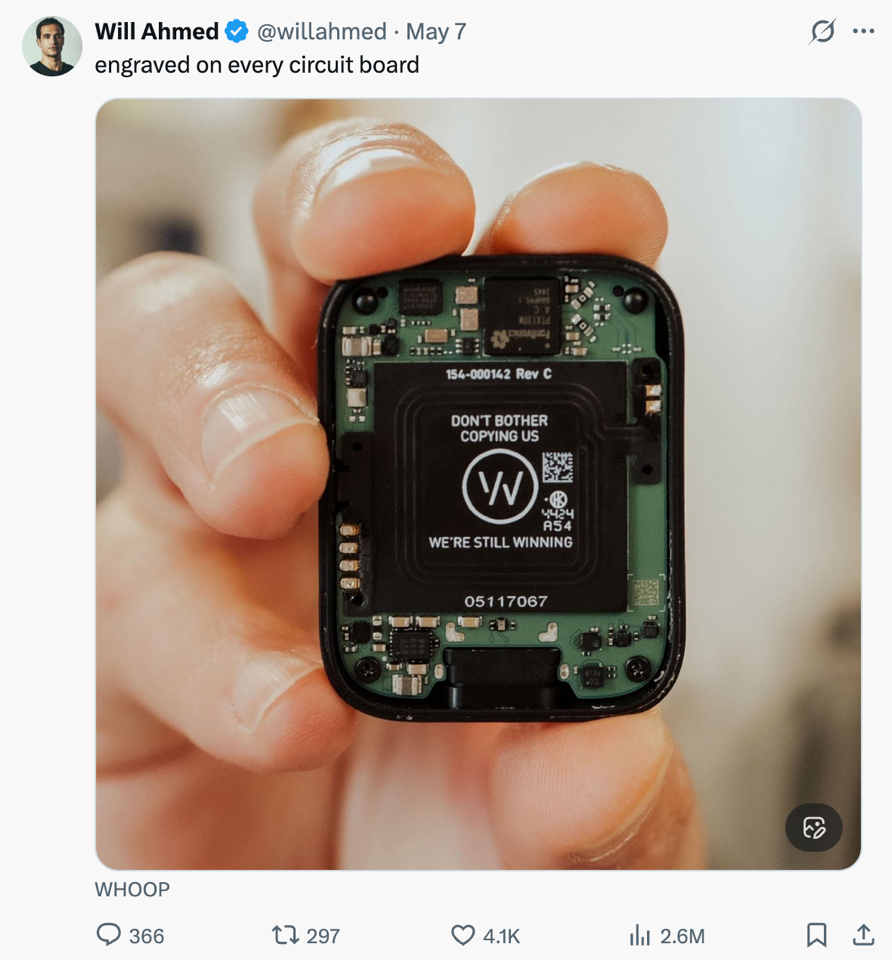
I find this peculiar, because in most cases, they’re…umm…not winning. At least, assuming valuation or subscribers or users is what matters.
For example, Whoop is heavily rumored to be preparing for an IPO, which currently has the company valued in the $10 billion range (with a ‘B’ like bubble). Sure, that’s impressive, but just for context, Google is valued at ~$4.5 TRILLION (with a ’T’, like trampled).
And certainly, there’s far more Fitbit/Google users out there than Whoop users. Whoop sits at 2.5 million users globally, whereas Fitbit alone is well into the upper 30-million active user range (Fitbit recently revamped a page that had listed an exact number from a few years back).
Don’t get me wrong, Whoop is super popular, and they do a lot of things technically right. And some things are technically better than what Fitbit has with the Fitbit Air today. For example, Whoop’s automatic exercise recognition is leagues beyond what Fitbit has (which only automatically recognized a couple of sports). Likewise, Whoop’s heart rate broadcasting feature makes Fitbit’s look silly and hyper-limited. Whoop’s journaling feature exists where Fitbit doesn’t really have anything like that (save some general daily notes, which aren’t the same). Finally, I think Whoop’s collection of band offerings, however pricey they are, vastly beats Fitbit’s current offerings.
But of course, the inverse is also true. Fitbit’s AI pieces in their updated app run circles around Whoop’s, and Fitbit’s concept of Cardio Load as well as Readiness, are well beyond Whoop’s relatively basic concept of Strain & Recovery (as I’ve pointed out for years). Likewise, Fitbit’s massive list of partners for integrations will soon become a key engine in its story.
The point is, bravado has its place (especially in sports), but these actions together seem less bravado and more scared.
What Really Matters:
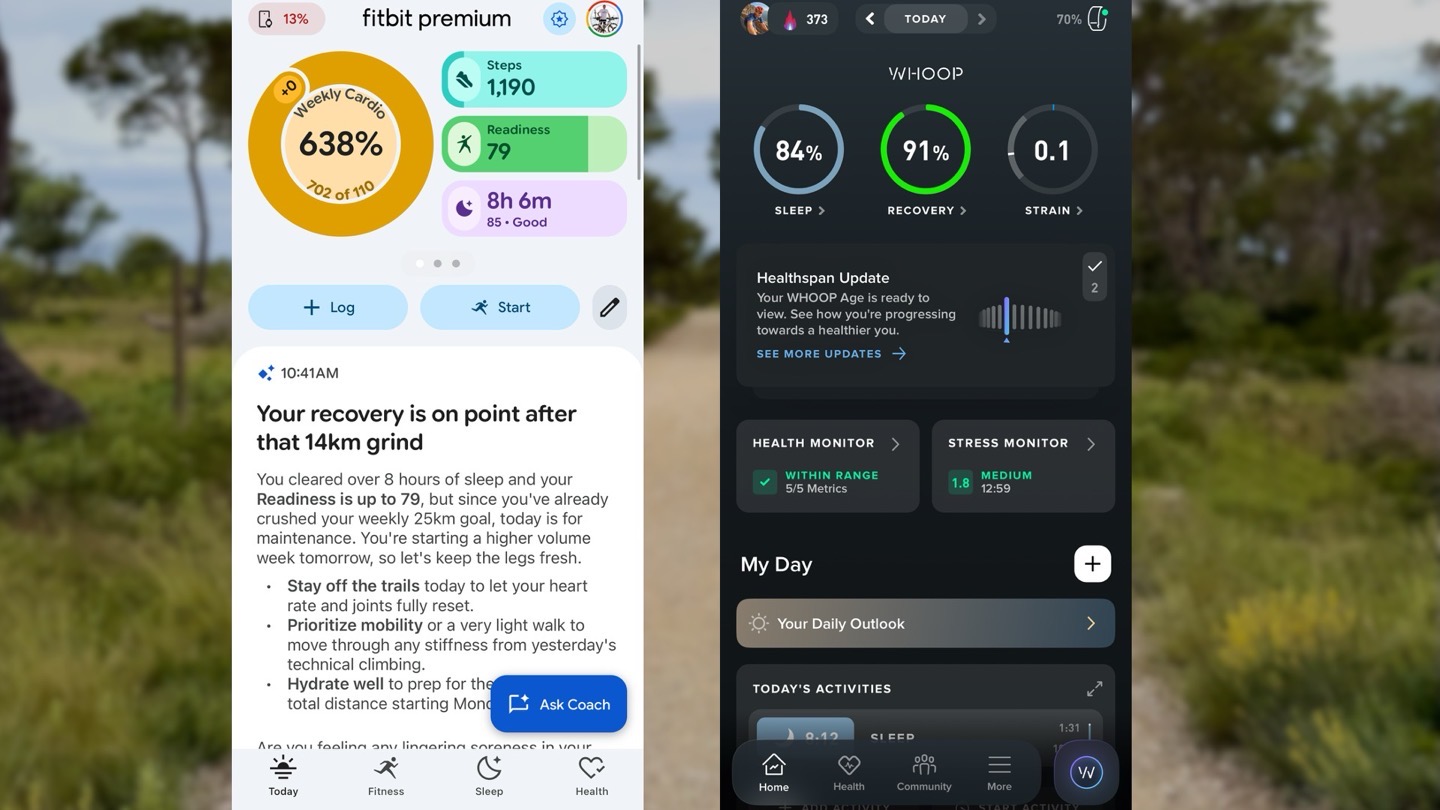
The thing is, as any Reddit comment, X/Twitter reply, or YouTube comment will tell you, there’s really only one thing that Whoop users are actually upset about: The price.
That’s fundamentally the issue here, and in many ways, it always has been. Nobody is really complaining meaningfully about features in Whoop. Sure, there’s some broken promises (especially in last year’s hardware debacle), and there’s some software features that haven’t materialized as fast as Whoop promised. But at the end of the day, it’s the price that’s going to drive people from Whoop to Fitbit (or other competitors).
When people look at something like the Whoop MG, with its pricing at $359/year, after 3 years, that’s over $1,000. Whereas a Fitbit Air is still $99, or at worst $400 with three years of Fitbit Premium. And while the Whoop MG does have some other aspects (like full manual ECG), other pieces such as the Blood Pressure haven’t really panned out. Even at a more basic level, you’d be looking at the cheapest Whoop offering being $600 for 3 years, versus the cheapest Fitbit option is $99 for those 3 years (just the hardware cost).
And while I totally get that there are key software differences in comparing Fitbit Air with Premium vs Not, I’ll save those for a more in-depth post. But the reality is, a huge chunk of the market today doesn’t subscribe to Fitbit/Google Premium and isn’t at all upset about it.
Either way, it’ll be interesting to see what Whoop’s next moves actually are. Sure, there was the rambling list of planned changes, but I don’t see any of those being enough to sway people. As always, instead, money talks.
With that – thanks for reading!


0 Commentaires