The Apple Watch Series 12 arguably draws one of the biggest lines in the sand we’ve seen yet from Apple, within the core Apple Watch evolution. Not because it looks different from the outside (it doesn’t), or even because of the changed processor/chipset (moderately different). But instead, because of the changes in software features that Apple has tied to the new optical heart rate sensor package. As a result of that, there’s a host of new features that are only available on the new Series 12 (and Ultra 4), which aren’t going back to previous Apple Watch Series owners.
Thus, for this review I’ll dive into all the nuances like normal – but I’m paying special attention to the new Readiness Score pieces, the heart rate accuracy of the much-touted new heart rate sensor, as well as ultimately whether or not this upgrade is worthwhile. And of course, within that, which people it makes the most sense for.
Note that as usual, there’s also the full video review above. There’s certainly some overlap, but also some pieces I cover within the video review I don’t hear, and vice versa.
With that – let’s get right into all the newness!
What’s New:

The Apple Watch Series 12 might look identical from the outside, but internally it’s got an entirely new processor, along with a boatload of new software features. Most of those features are lit up today from launch, but some of them won’t come to later on (a portion of the Audio Intelligence features). Further, all of the new Series 12 internals (processor-wise) are shared with the Apple Watch Ultra 4 that was launched the same day. Here’s how it differs from the Series 11:
Apple Watch Series 12 Hardware Updates/Changes:
– Gets new S11 chipset, which has features from the new A20 Pro chips of the iPhone 18 Pro
– Gets new secure audio processing exclave within that (for Audio Intelligence)
– Series 12 increased battery life to “over 2 days” (50 hours, technically)
– Series 12 adds revamped ‘Extended Battery’ (GPS) mode and new ‘Max Extended Mode’ (increasing workout GPS modes, though Apple doesn’t make battery claims on the Series 12)
– Boatloads of new bands for all of them, including new Nike bands
– New aluminum gold color
– New Hermes options as well
Apple Watch Heart Rate Sensing Hardware Update:
– New heart rate sensor with increased electrode surface area for better ECGs
– New photodiodes below it for better workout capture
– New LED array below that for better 24×7 HR readings
– New HR sensor is thinner (bump) than in the past
– Increased background (non-workout) HR readings to every 5 seconds (60x more than before)
– Increased HRV readings to every 5 minutes (24x more than before)
– Claim of Apple Watch Series 12/Ultra 4 “Most accurate heart rate sensing in a wearable”
– Published their own white paper to support that claim, with competitor comparisons
New HRV Features:
– Added overnight HRV trending/recording within the Vitals app (as one of key metrics)
– Added new HRV into new ‘Daytime’ view in the Vitals app
– Requires 7 nights of initial data on a watch to get HRV trends in the Vitals app
New Readiness Score Feature:
– Each morning you’ll get a new score
– Score is based on a range of 0-10 (zero being worst, 10 being highest)
– Four core descriptors you can get: Recover, Pace Yourself, Ready, Go For It
– Can be viewed on the watch or the Fitness App
– Leverages your Sleep data, Vitals Metrics, Training Load, and recent Activity data
– Requires 7 nights of initial data for the HRV trends, before it can populate Readiness Scores.
New Health App Redesign (on phone, coming later this year):
– Adds new AI summary and recommendations
– Adds Apple Intelligence guidance, including suggesting intervals
– Adds new Health Age: Based on Sleep, VO2Max, HRV, Heart Rate, Exercise Minutes, Steps, and optionally Labs
– Adds new longevity Tab, based on Nutrition, Metabolic, Overall Movement, Sleep, Hearing, Heart metrics, mental wellbeing
– Adds support for pulling in lab work
– Adds new VO2Max test (test can be done in living room in 6 minutes)
– Adds new other tests for flexibility, movement mechanics, strength, and more, which can be trended.
– Health app coming later this year in beta in English
New Audio Intelligence features (on-device, some features later this year):
– Everything done on-device, without need for your phone (at least for immediate processing)
– [Available today] Adds Sound Recognition alerts for sirens, doorbells, baby crying, and more (shows up as text on watch)
– [Available today] Instant Shazam: Will instantly show you the name of songs when you raise your wrist
– [Available later 2026] Live Rewind: Double-tap the Digital Crown to get a text-only transcription of the last 15 seconds of spoken words
– [Available later 2026] Siri Recap: Will summarize conversations/spoken words heard around you into a recap that’s available on your phone.
– Can configure all features independently (enabled/disabled, plus further focus-mode-like controls for Siri Recap)
Got all that? Good, so let’s dive right into all the stuff you need to know when using the watch each day.
Daily Usage Basics:

In this section, I’m going to cover all the day-to-day basics of using the Apple Watch Series 12, mainly from the perspective of health, wellness, and sports/fitness. I’ll cover some of the other basics as well, but there’s plenty of other resources for things like playing back music, contactless payments, or 3rd party apps. None of which have changed in many years on the Apple Watch. So if you’re familiar with those from anytime in the last decade, it’s all the same as before. The key exception being the Audio Intelligence features, which I break out into their own section down below later in the review.
Of course, it’s worth noting that the Apple Watch Series 12 does indeed require an iPhone. It’s unable to be initially setup/configured without an iPhone, and you’ll need an iPhone 11 or newer that’s running iOS27 (the full list is here). Further, for the newer Audio Intelligence features, those need an iPhone capable of Apple Intelligence, which is essentially an iPhone 15 Pro, or any iPhone 16/17/18. That’s also true for the Apple Workout Buddy features too. Or really, anything depending on Apple Intelligence. But, if you don’t care about those aspects, then just an iPhone 11 or newer will do fine.
With that set, onto the watch basics itself. The 2,000-nit display remains the same as last year, which is more than bright enough for even the sunniest of days. I live on a Mediterranean island, with plenty of bright direct sun, and I’ve had zero issues seeing the display at any time. The screen size is the same as last year, which is almost identical to the Ultra 4. Both watches support minimum brightness down to 1-nit, which ensures it doesn’t blind you in the middle of the night. Here you can see the two screens side-by-side on a bright day in direct sun:

Next up, the interface basics. The Apple Watch Series 12 has essentially two buttons, though one of them also rotates and presses inwards. Plus of course, the touchscreen itself. In the upper right, you’ve got the Digital Crown, which you can use to rotate through menus, and then also open the quick access menu to get to recently used apps (and Siri), like seen below.

Meanwhile, the lower right button opens up the controls dashboard to check battery, turn on the flashlight, set focus modes, and more. The focus modes will sync between your iPhone and watches instantly. Handy when you want to head to sleep early, simply toggle the bed icon on either watch or phone, and boom – all of your devices are instantly in sleep do-not-disturb mode.


Speaking of sleeping, it’s probably worthwhile mentioning one of my favorite new features of the Series 12 is the incredibly fast charging for topping off the battery. Just 5 minutes of charging is enough time to get 10 hours of sleeping time. This is achieved through both updated charging algorithms, as well as changes in the charging puck itself. Nonetheless, there have been countless times in the last 3 weeks where being able to throw it on the charger for those few mins means I didn’t have to worry about it not tracking sleep data.

This fast charging also extends to more than just sleep times. You can charge the Series 12 to 80% in 30 minutes, and 100% in 60 minutes. When I did fully charge it, I got somewhat variable battery. The first week or so, battery life honestly wasn’t super great. I was barely making it 24 hours, and even that was iffy at times. This is with 1-2 hours of GPS activities, but sometimes none. However, over the last week, things have notably chilled out, and now I’m comfortably getting the usual 1-1.5 days I expect.
For example, one night a few days ago:
12:20AM: Charged to 100%
25 hours later (1:20AM): Down to 45%
37 hours later (7:30PM): Down to 10% (and then I charged it)
I’m quite happy with that.
Anyways, back to some quick basics. You can lightly customize the watch face by long-holding it, which brings up watch faces you can choose, and then from within that you can select from a slate of complications. Still, Apple doesn’t allow/have 3rd-party watch faces like most other brands do, so you’re kinda stuck with what they have. Though, what they have is pretty darn nice. I tended to float between the ‘Nike Globe’ and Exactograph’ ones you see below:


Whereas my wife preferred the moving lava-lamp style ‘Flow’ watch face you see below:

Depending on the watch face, one of the complications you can see is your daily activity rings. You’ll often hear the term ‘closing your rings’, which refers to closing each of the three Apple rings each day.

These are pinkish for movement, greenish for exercise, and blue for standing (once per hour). Below is an example of my rings from today, where you can see it was a mostly quiet morning, and then I did an afternoon run. Later on I’ll jump on the indoor bike for a bit:


All of the above are accessed within the ‘Activity’ app on the watch, though are mirrored to the ‘Fitness’ app on your phone (and also visible within the ‘Health’ app on your phone).
One of the next metrics is your sleep stats. These can be found within the Sleep app on the watch, which is often on the watch face as a little bed icon. These are tracked automatically and are critical to getting Readiness Scores.


From an accuracy standpoint, I focus primarily on the times I went to sleep and the times I woke up, which, it nailed within ~5 minutes each night/morning. Note however that I don’t compare sleep phase/stage data (e.g. REM/Deep/etc…), because doing so would basically be fake science. The ‘best case’ scenario for accuracy of a pro-level ‘gold-standard’ device is only in the low 80% range, and we’d never use a comparison chest strap that was only 80% accurate to judge workout accuracy. So, I’m not going to mislead you here and do the same. Instead, I focus entirely on the sleep times, which I find is the majority of what you need to know in terms of whether or not you’re getting enough sleep.
Next, there’s a new Apple Health app coming later this year. It’s just started rolling out as a developer beta, so it’s not fully available yet. But the gist of the changes here are that it takes Apple Health from being a nightmare for regular people to navigate to a much more consumer-friendly app. Previously, Apple Health was really the app that developers dumped data into for HealthKit. So it wasn’t exactly meant as a place my Mom would open up and try to use. But these days, Apple has started shifting more features into it, including a bunch of health and wellness tests you can do, data about your sleep, and plenty more.
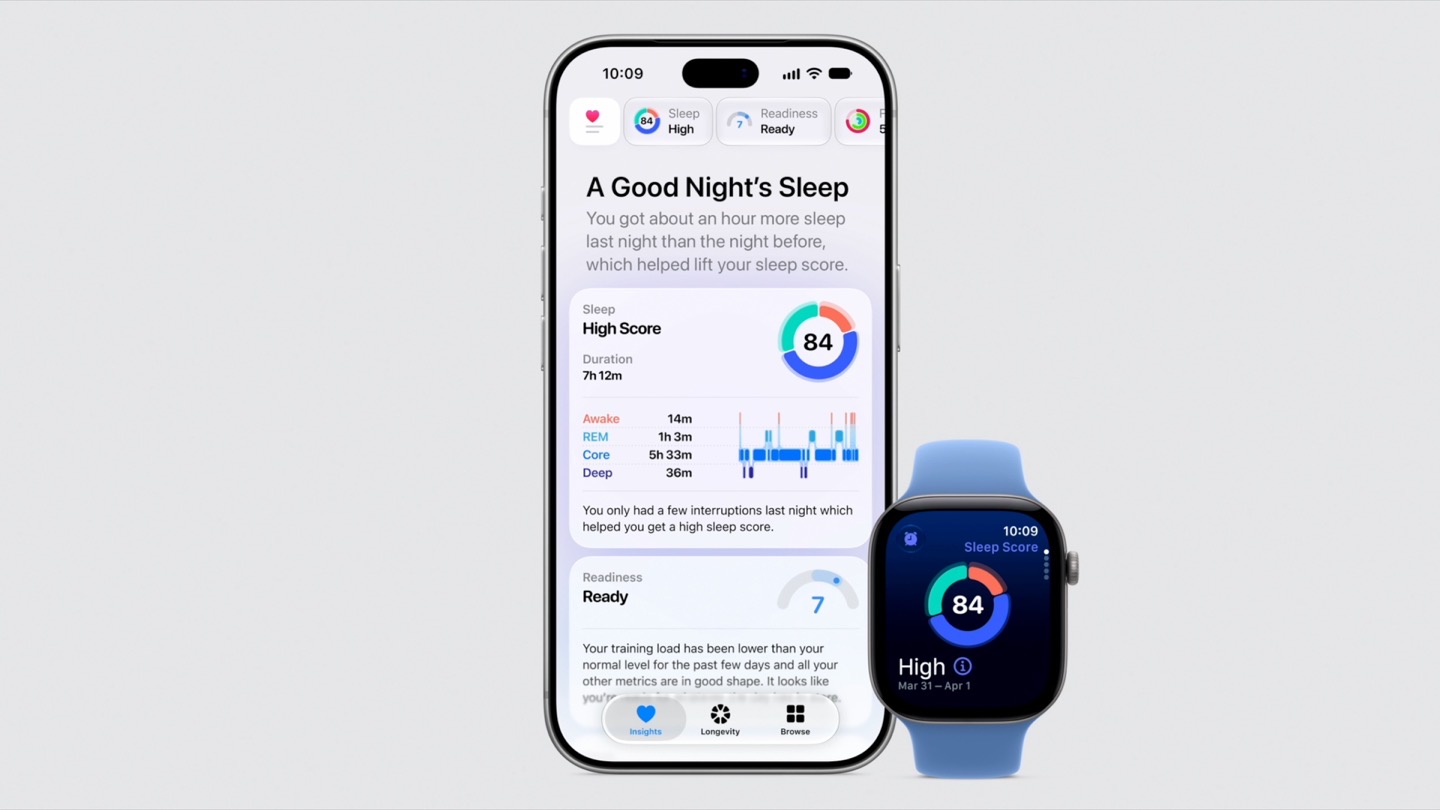
I’ll dive into that in more detail down the road, but looking at it briefly, things are looking really good compared to before. The geekery from before is still all there if you need it, but now front and center it’s much cleaner and more simplified for every day usage. But again, more down the road
Finally, a few minor leftover hardware notes. First up is of course, the new optical heart rate sensor on the back. I’m going to dive into all the heart rate accuracy pieces later in the heart rate accuracy section – so stay tuned for that. Likewise, in the next section I’m going to go into the new HRV pieces, as well as the dependent Readiness Score & Vitals pieces that leverage it. Still, here’s what it looks like:

The new sensor expands the electrode area for improved ECG’s, plus a slate of changes I outlined earlier to improve/increase heart rate readings.
If your region supports ECG, the Apple Watch has medically certified ECG readings on it, as well as background AFib detection. To use these features, you’ll need to do a quick onboarding piece that explains (numerous times) that the Apple Watch doesn’t detect a heart attack. Again, it doesn’t detect a heart attack. Instead, it’ll record an ECG that you can send to a doctor. To do so, you’ll simply wear the watch and then place your finger on the Digital Crown:

Once that’s done, you’ll get an ECG summary that confirms if it detected an abnormal sinus rhythm (such as Atrial Fibrillation, or Afib), as well as the ability to add symptoms. Then from there you’ll get a PDF of the actual ECG itself, that you can send to a doctor.


Meanwhile, last but not least are the bands/straps. The Apple Watch bands haven’t changed here, and you can continue using existing bands you might have, or buy other ones from Apple/Amazon/Aunt Band. These simply pop off by pressing the button under the watch edge, which releases the locking mechanism:

Then swap as you see fit. I’ve mostly been using the stock olive-colored band that came with the bronze unit. At first I was kinda ‘blah’ about it, but it’s grown on me. But for fancier date nights, I also used the Milanese loop band, which looks really nice with the bronze coloring on the watch:

Meanwhile, my wife simply used the white band that came with her watch. I didn’t have any other fancier shorter-watch straps for her. Sorry!
Readiness Score & Vitals (including HRV):

Next up, I want to dive into the new Readiness Score features, as well as the updated Vitals app – which now includes both nighttime and daytime HRV (Heart Rate Variability). In the future, this would normally just be wrapped into the ‘Daily Usage Basics’ section above like most of my reviews, but given it’s new here, I figured I’d pull it out into its own section and make it a bit more detailed. Plus, I’ve now got even more time on the Readiness Score piece than my Ultra 4 review a few weeks ago.
To quickly baseline, though, the new Readiness Score from Apple is more or less the same concept as other readiness scores we’ve seen from Google and Garmin, which are a bit more advanced than the basic recovery and strain scores you see from Whoop and Oura. Further, in the case of Whoop/Oura, those are one-time morning scores (recovery), whereas Garmin & Apple’s scores are dynamic throughout the day. Meaning, they show an initial value when you wake up, and then respond to different parts of the day, such as doing a hard workout (or two workouts), as well as even taking a nap.
Apple’s Readiness Score has two key components: A numerical value and a descriptor. The numerical value is from 0-10 (with zero being the worst, and 10 being the highest). And then within that, there are four descriptors you can get. Here’s an example of my score as I sit here mid-afternoon typing this at ‘7’ and ‘Ready’, with some icons below it indicating the supporting categories (Activity/Workouts, Vitals, Sleep):

You can see my score was a ‘7’, with a descriptor of ‘Ready’. Here’s a quick list of the descriptors available and their corresponding ranges
– 0-1: Recover
– 2-4: Pace Yourself
– 5-7: Ready
– 8-10: Go for it
These scores are in turn based on four core umbrella categories:
– Fitness: This is primarily your workouts, but can also include other activity
– Overnight Vitals: This includes your overnight resting heart rate, respiration rate, wrist temperature, and overnight HRV
– Daylight Vitals: This includes your resting heart rate during the day, and HRV during the day
– Sleep Score: This is your sleep score from last night, based on sleep times/durations/phases
Getting a readiness score requires some historical data, specifically 7 nights of sleep data, at least 4 hours of sleep per night. Further, that’s on a per-watch basis. In the unlikely event you change watches, you’ll need to ensure that you’ve also got wrist temperature and respiration rate data for some of those nights as well. But for most people, if you just sleep with it 7 nights, you’ll be totally good to go.
That said, as you might expect, the more data, the better. In my case, my initial 7 nights included an 11-hour redeye flight across the ocean (with barely 4 hours of sleep), followed by days of yo-yo’ing jet lag sleep. So, my initial seeding sleep/HRV data was a hot mess. That said, it does pull in your historical activity data beyond that, which helped to normalize things a bit.
In any case, starting off with an example day, where I woke-up with a ‘8’ in the morning, indicating to ‘Go For It’

And that stayed as-is till around 1PM, when I went out for a 2-hour road cycling ride with my wife:

This wasn’t a crazy hard ride or anything, just kinda medium intensity up the climbs, and chillax on the way back down out of the mountains. Still, once I finished the ride the watch notified me that the readiness score had dropped down to a 5 (from 8 earlier), indicating I’m still Ready to take on more load.

That’s logical, given my ‘readiness’ to tackle another workout or some other training load was now lower than before. Now in my case, I went about writing/editing for the next few hours. But had I instead taken a nap, perhaps I’d have improved that to ‘6’ during that timeframe.
In any case, fast forward a few hours later, and we’d go do an evening track workout. This one was actually quite solid. Not ‘I want to die’ painful, but enough to re-think my few-hour ride earlier.

Once that was completed, the watch then dropped my values again, this time down to a 3, which is to ‘Pace Yourself’:

Again, that seemed logical to me, given the intensity of the workout. In fact, it’ll even note that below it, saying *why* it dropped your values:

What’s perhaps even more interesting is to fast-forward a week later, when I wasn’t feeling all that great – a bit under the weather. In this case, I had basically ceased daily workouts to mitigate things, but I still managed to drop down to a score of ‘1’ (almost as low as you can go, which is a ‘0’.) In this case, it was clearly upset about life. Unfortunately, in my haze I forgot to take a photo of this on my Apple Watch Series 12, but here it is on the other wrist with the Ultra 4:

Certainly I wasn’t feeling well, though as evidenced by the handlebars in the background, I still do an hour-long bike commute to pickup some new products. Hey…gotta get the job done! Plus, it was an e-bike, so…yeah.
And you can see the reasons it gave as well, managing to trip both the low vitals and low sleep score triggers. My Fitness score was fine, mainly because I had already pulled way back on training.


If you have an outlier (as defined as a comparison to your personal historic baseline), then it’ll turn pink (as seen above). If you have multiple outliers, it’ll also push a notification to you to be aware of it. These outliers can and will also drag down your Readiness score. In fact, when it comes to ‘why’ your Readiness score is lower, you can see that both within the watch, as well as the ‘Readiness’ chunk in the Fitness app (and eventually the new Apple Health app).
Now, that said, the Readiness Score isn’t without its wonk. There have been countless times over the last few weeks where the values are just null for either a few seconds or even longer than a few seconds. That seems to have improved with a firmware update a couple days ago, but still, it clearly wasn’t ready to launch when it did.
Setting that aside, one of the core pieces that the Readiness score depends on is the HRV values (heart rate variability), which include both your nightly and daytime scores. These values are seen within the updated Vitals app. Here you can see the new nightly HRV values each time you wake up, showing your value from last night and how that compares to your baseline:

Apple takes these values all night long, every 5 minutes, and simply averages them during asleep periods. This is similar to what other companies do. If I compare my values from last night, for example, here’s how that shakes out. Apple now uses RMSSD for their nightly/recovery HRV values (and all values shown in Vitals), letting you compare it with others (whereas in the past they used SDNN, which wasn’t easily comparable):
Last Night (Late night workout):
Apple Watch Series 12 (Wrist): 40ms
COROS Pace 4 Pro (Wrist): 42ms
Fitbit Air (Bicep): 35ms
Garmin Cirqa (Bicep): 42ms
Oura Ring Gen5 (Finger): 45ms
Whoop 5.0MG (Bicep): 47ms
Previous Night (Normal Night):
Apple Watch Series 12 (Wrist): 50ms
COROS Pace 4 Pro (Wrist): 56ms
Fitbit Air (Bicep): 42ms
Garmin Cirqa (Bicep): 58ms
Whoop 5.0MG (Bicep): 68ms
This is actually quite varied compared to what I tend to see as comparisons. Usually the values tend to be within 2-3ms across the board, though I do consistently find that the Fitbit Air is the outlier.
In addition to nighttime values, Apple now also takes daytime values. It’s also worthwhile noting that only Huawei takes and surfaces these daytime HRV values, whereas other companies tend to consolidate them into other scores (e.g., stress scores). That’s likely because the daytime values are super variable, and only taken when at rest (not walking, nor workouts, etc…). You can see your daytime score by opening up vitals, and tapping the little bed icon in the upper corner, which toggles it to a sun:

But here’s where things get pretty messy. Apple is actually comparing to your historical values for that given time slice of the day (e.g., comparing your 2PM values to your historical 2PM values). And those historical values exclude any periods of movement or workouts. In other words, for an active person it may take far longer to build up a daytime HRV baseline, because you’ll get very few (if any) daytime HRV data points. For example, take a look at my data points here, and focus on the ones roughly between 9AM and 11PM. And so earlier on I had zero values for a given hour time slice (e.g., 2-3PM), and thus this wouldn’t show at all. Point being, it can take way more than just 7 days to get values for all the hours of the day.


And even once you have those values, frankly, I’m not sure what value they are. I know a *LOT* about HRV and trending and the like, yet when it comes to daytime trending of HRV data, there’s a good reason most wearable companies don’t do it: It’s just not very useful. And certainly not super intuitive, given both the circadian rhythm aspects that Apple says drive their hourly time matching, as well as just the reality of differing/shifting schedules. Plus the fact that any movement periods are zeroed out.
As I said in my Ultra 4 review, I appreciate Apple going a bit geeky here, but equally, out of all the heart rate areas they could have gone more geeky (like proper Bluetooth heart rate broadcasting to 3rd party devices), this specific daytime HRV area seems uncharacteristically confusing and messy for Apple.
Meanwhile, one last area of note is that the Apple Watch Heart app has been revamped a bit. For example, you can now actually see those HRV values. Below you can see the gaps when I was moving around/active (since it doesn’t measure HRV then), as well as my workout times having gaps.

Especially when you simply compare it to my day’s HR plot:

Now, I’ll be doing a full comparison to Garmin/Whoop and other recovery/readiness scores in the near future. But I wanted some of my data to settle a bit, given both the newness, as well as the fact that my initial days were full of all sorts of shifting sands (like transatlantic flights). Whereas the other non-Apple devices have much more baseline data to pull from, to be able to separate out a few random nights impacting that baseline creation. Stay tuned for that!
Sports Tracking:

I think probably one of the most rarely stated but interesting things to know about the Apple Watch Series 12, is that it’s got the exact same sports profile features as the Apple Watch Ultra 4 does, in terms of general sport profiles, exercise features, and more. Really, the only Ultra series differences in the greater sport realm come in the form of deeper depth gauges/certification for diving, as well as the emergency siren. Albeit, we do have to mention the annoying lack of ‘Precision Start’ on the Series 12. But more on that in a second.
To start with a sports/fitness/workout activity, you’ll open the ‘Workout’ app. There’s a number of ways you can get there, but you’re looking for the little runner-man icon, which brings you to this page:

This page is where you get to choose your sport mode (e.g cycling, running, etc…), as well as customize various settings. The Series 12 supports all the same sport modes as the Ultra 4, and you can find the full list here. The general rule of thumb with Apple Watch sport modes is that while they have most sports covered, they won’t have separate modes for each variant within a sport (e.g. Trail Run vs Run, or Mountain bike vs Road Bike). Instead, it’s all just ‘Outdoor Run’ or ‘Outdoor Cycle’.
Once you’ve selected a sports mode, you’ll see in the upper corners that there are four ways to get into additional settings/features (shown above):
Upper left: Workout Views (aka your data pages/settings)
Upper right: Workout goals & structured workouts (aka the different ways you can have the watch tell you to suffer), including the new Extended and Max Extended modes
Lower left: Music (all things music)
Lower right: Workout Buddy & Voice Alerts (thus, all things voice-over related)
For example, if you want to customize the data fields/pages you see during a given sport type, you tap that upper left ‘Workout Views’ icon and then tweak the data pages here. Like with the sport profiles, you don’t quite have as much customization or data field creativity as you might on a Garmin/COROS/Suunto watch, but you got the main fields you’d probably want/need.


Meanwhile, the Apple Watch does support custom structured workouts. You can sync things from platforms like TrainingPeaks, Strava/Runna, etc… Or you can create your own on either the watch or your phone. All of this works perfectly well, and was introduced over the past 1-2 years.


However, one new feature you’ll find this year with the Series 12 (and Ultra 40, is the new ‘Extended’ and ‘Max Extended’ battery modes, within the workout pages.


Somewhat quirkily, while Apple defines the battery durations of these modes for the Ultra 4, they don’t do so for the Series 12. However, assuming the same rough math applies here as it does to the Ultra 4, you’re looking at about 25% longer battery life in ‘Extended’ mode, and about 2x longer for ‘Max Extended mode’. Again, that’s just a rough swag, since Apple doesn’t publish any battery numbers there. Here’s what gets turned off in each mode:
Extended mode: Retains everything but turns off always on display, and running form metrics turned off. Cellular operations gets batches a bit. Everything else remains on, this is effectively the previous ‘Low Power Mode’ renamed.
Max extended mode: Retains 1-second GPS update rate (with dual/multi-band satellites), HR data recorded at every 5 seconds like normal, but showing a 5 minute rolling average on screen instead of instant updates. No splits, no alerts, no custom workouts. Plus previously cellular batching, no running metrics, and display not always-on.
With all that covered, it’s time to start a workout. In the case of the Series 12 (and all non-Ultra Apple Watches before it), there’s a 3-second countdown when you press start. Then it goes off and finds GPS/satellites, and secures your heart rate lock. This is mildly annoying, especially for races, because while you can tap to skip the countdown, it’s only then that it starts looking for satellites. Thus, from a race start standpoint, you either choose to add extra time before the start line, or you get a delayed start after the start line. Both suck. And frankly, it’s ridiculous that you can’t just go into a pending state like every other GPS-connected watch over the last nearly 20 years. Yes, it’s actually been that long.
Once in a workout, you’ll see all the data pages you’ve configured, plus any leftover default/stock ones you left.

If you’ve left Workout Buddy enabled (which is Apple’s sporty AI assistant that encourages you to suffer longer), it’s actually aware of your Readiness scores, and will generally include tidbits about said score in your workouts (and whether it thinks it’s a good idea for you to be doing whatever it is that you’re doing). That said, as was the case when Apple introduced the feature last year, I still find it makes an astonishing number of hours, frequently hallucinating random data tidbits in nearly every workout. Most of the time they aren’t life-altering errors, but instead are weirdly phrased things, or just straight-up saying the wrong kilometer markers or such. Of course, you can still turn this off on a per-sport mode basis if you’d like.
Once your workout is done, you’ll get a slate of summary workout stats on the watch:


And then you can dive into slightly more detail in the Apple Fitness app:


Now speaking of diving into things, the Apple Watch Series 12 has a depth gauge that supports underwater depth information down to 6m/20ft. Unlike the Ultra 4’s depth gauge (which goes to 40m/131ft), this one isn’t certified for scuba usage. But, for most people just snorkeling or playing around in the water, 6m/20ft tends to be roughly where you’ll probably bottom out.

On the watch, it’ll show your current depth information, as well as track individual ‘dives’, in much the same way it would in a workout. If you go beyond the 6m/20ft depth, it’ll tell you that it’s too deep to track the depth, and once you’re back within the 6m/20ft, it’ll continue showing depth information.


All of your ‘dives’ are displayed within the Fitness app, like seen below. The depth app will automatically engage when you submerge past 1m in depth. Though you can disable that if you want.


It’s a handy feature that I appreciate, and the 6m/20ft strikes a good balance without needing the additional certification/safety aspects that the deeper depth gauge would warrant.
Now, one of the metrics you’ll see after a workout is your Effort Rating. This is a score that it initially estimates, and you can tweak, about the intensity of the workout. In other words, how much did you suffer:

This score is the basis of Apple’s training load features. Unlike most other endurance-sports companies that estimate training load based on heart rate or power numbers, Apple uses your score in combination with the duration. That has pros and cons. The negative side is that you might underestimate the impact of a given workout, or, it might be hard to assign meaningful scores to both short and much longer workouts (as they can be ‘hard’ in different ways – such as intensity vs. duration). On the flip side, Apple’s system is much better for really long-duration but somewhat low-intensity activities like a 8-10 hour hike. In that scenario, you can effectively force training load higher, whereas most endurance sports watches will given a training load amount equal to a 5KM run.
In any case, from there you can see your training load trending over time, and how it compares to your historical norms:

Still, if you’re quite into sports data, you might find this all a bit thin. The good news is there are tons of apps that can leverage the data Apple puts into Apple Health, to do more advanced analytics.
As I’ve said before, one of my favorites continues to be HealthFit, which I use for syncing data to numerous data platforms (including now the DCR Analyzer), but also tons of other platforms. And then beyond that, it has tons of ways to analyze your data.


I don’t have any skin in the game there; it’s just an app I’ve been using for more years than I can count. And I appreciate that there’s a real human developer dude behind the scenes, and isn’t just another vibe-coded AI slop app. My inbox is full of those, sadly.
Further, another example I’ve started using on the mapping/route side is WristTopo. I’ll be doing a separate piece on this shortly, as this vastly beats what Apple has in their own super basic routing features. Further, the native Apple mapping/routing features are very limited in their coverage areas (mainly just US parks), and not super functional outside of that. Whereas WristTopo has global offline mapping options, route creation tools, elevation profile charts, turn-by-turn navigation, and even custom data pages. Plus, all your data ends up back in the same Fitness app that you use normally.


Again, more to come on that front here shortly. In the meantime, let’s look at some of the accuracy pieces.
GPS & Heart Rate Accuracy:

The Apple Watch Series 12 has a new optical HR sensor, which includes both new hardware and new software features that I’ve outlined earlier (like the frequent HRV updates and now-5-second background HR update frequency). Here’s the quick recap on those features:
– New heart rate sensor with increased electrode surface area for better ECGs
– New photodiodes below it for better workout capture
– New LED array below that for better 24×7 HR readings
– New HR sensor is thinner (bump) than in the past
– Increased background (non-workout) HR readings to every 5 seconds (60x more than before)
– Increased HRV readings to every 5 minutes (24x more than before)
– Claim of Apple Watch Series 12/Ultra 4 “Most accurate heart rate sensing in a wearable”
– Published their own white paper to support that claim, with competitor comparisons
But the better question is whether or not that accuracy paper/study represents the real-world testing I saw, and if not, why not?
I dive into this in the video quite a bit, and will probably expand it out into a separate post. But the key thing to understand is that the Apple Watch Ultra 4 and Series 12 only have an update frequency during workouts of “on average” every 5 seconds within a workout. It can be every second, or every 3 seconds, or every 5 seconds…but it can also have gaps of 20 seconds. All of that depends on whether or not the HR sensor algorithm decides it has enough quality confidence to plot that data point. If not, it simply skips it.
Think of it like this illustration as a timeline (this is just something I quickly whipped up to show you how it works after multiple discussions with Apple):

From there, Apple will throw away anything that doesn’t meet its quality confidence level, thus leaving you with something like this:

Now remember that all other wearables simply always plot a data point every second, including every one of the competitors in Apple’s study. Further, in Apple’s study they *only compared the exact data timestamps from their file, to the reference Polar H10 device”. Meaning, using the example above, they only compared the values for the green dots. Not all the missing timestamps.
And as you’ll see, Apple has a lot of missing timestamps, especially when it’s unsure. So, rather than give you the wrong answer, it simply gives you no answer at all. And from a study grading standpoint, it was designed such that “no answer” = “the correct answer”. Which…ummm…is very slanted towards Apple, to say the least.
But setting aside Apple’s lopsided study, let’s look at the actual accuracy of the data. Because, to be fair, it’s very good. Is it better than its best competitors? Probably not; it seems about the same. But again, it’s really good.
First up, a relatively steady trail run:

At a high level, this looks very, very good. No major concerns here. But of course, when we zoom in, we’ll find countless examples of sub-5-second gaps, and other gaps like this one here for 11 seconds. In this case, the Apple Watch is factually wrong – both with the gap and without the gap. Remember, in the study scenario, it wouldn’t have been docked points for this, because it didn’t plot a point.

Next, what about a Peloton bike ride, with some solid intervals in there? Again, at a high level, this looks really good:

And indeed, it is good. Except there’s still plenty of gaps here, like this 12-second one. And of course, on the watch itself, it’s also only opening the heart rate display every 5 seconds (regardless of data points). So any fast-moving intervals will be wrong 80% of the time on the display.

Perhaps some rowing is next? Again, at a high level things look really strong – save for that one moment we see around the 8-minute marker that the Ultra 4 hiccups, though the Series 12 holds on:

Still, there are numerous other gaps, such as this 8-second gap here. In this case the difference isn’t really that meaningful though, compared to the Ultra 4’s issue above.

And again, we can do this all day long. Here are some 10x400m running intervals, which look very strong at a high level

Zoomed in, it’s still strong, but also with a number of gaps in there, sometimes shorter here, but certainly present:

Or this track run (8x600m), which looks fairly reasonable at a high level:

But once we zoom in, we see numerous moments where there’s ‘normal’ ramp rate separation for optical heart rate sensors:

And finally, an outdoor ride of a few hours. Again, at a high level this looks really good. Like, really really good. Exceptionally good, in fact:

And had it not been for Apple’s study, I probably wouldn’t have overthought it. But with the claims there, it’s hard to ignore moments like this:

Or these:

And these:

Again – I think overall Apple’s is actually delivering on a world-class optical heart rate sensor. And I fully understand their thinking of ‘not recording data points that don’t have a good confidence level’. I’m OK with that. Really, I am. But it seems disingenuous to then judge everyone else on a full data set, while Apple gets to ignore the ‘hard parts’ it can’t be sure of.
In any case, as for GPS accuracy, let’s quickly look at a few workouts. This is one of the sets of intervals I did around and around and around, and indeed, the Series 12 and Ultra were very good here:

Looking at this trail run next, at a wide/high level, everything looks quite good.

Once in the trails, we can see that the Ultra 4 & Fenix 9 are very close to each other, though the Series 12 isn’t quite as accurate (probably because it lacks multiband):

Here we can see though though on this fairly open stretch of roadway, that the Series 12 is off in the trees somewhere:

Though later on, the Series 12 outperforms the Ultra 4 for a few seconds…before going back through some buildings/bushes.

Meanwhile, on road cycling up in the mountains, things were pretty good. Here’s the high-level map:

And then, zooming in to these switchbacks, you can see things look fairly close between them, with a little bit more perfection from the Ultra 4 over the Series 12:

Though zoomed in further to this switchback, it’s hard to decide which one is most correct. They’re all good enough here:

When it comes to openwater swimming, I had pretty good luck with the Series 12. In fact, it handled better than the Ultra 4 did. Though, as long-time readers know, when it comes to one-off openwater swim tests, almost any device can have a bad day in the water. I tend to do more openwater swim tests as part of my larger head-to-head openwater swim guides, which I’m going to be working on here shortly. So I’ll re-test the Ultra 4’s bad day there. In any case, as you can see below, the Series 12 was near perfect here:

Overall though, from a GPS standpoint, the lack of multiband GPS/GNSS support is a bit of a bummer on the Series 12. Not because I need multiband support, but because it’s simply noticeable in everyday running. As I’ve said before, some brands have good enough GPS chipsets/antenna/software to overcome a lack of multiband. But in this case, the lack of multiband on a $400 watch, without making up for it in other ways accuracy-wise, has become the odd-man out in the watch world. I’m hoping/expecting that next year with a Series 13 we’ll see improvements in this realm.
Wrap-Up:

One of the things that makes the Series 12 notable over many years of Apple Watch (specifically within the Apple Watch ‘Series’ lineup), is that this is the first time in a long time where Apple is clearly saying, “you should be upgrading”. Unlike past years where the feature improvements were fairly minor year-to-year and/or nuanced in whether someone with last year’s model would even notice, this time, virtually every major feature is only available on the Series 12 (or Ultra 4).
If you have a 1-year-old Series 11, your watch doesn’t have the right sensor to gather enough HRV data to complete the overnight HRV trending. Nor the daytime HRV trending. And without that overnight HRV trending, you’re not populating that HRV data into the vitals app. And without that extra line item in the vitals app, you’re not getting a Readiness score. None of that goes to older watches. Likewise, all the other updated heart rate frequency bits, be it background readings or updated Heart app features. And even further support in the revamped Health App. And then going forward, as we look at the current and upcoming Audio Intelligence features, those are all only on this year’s watch
Certainly, existing watches get WatchOS 27, but even that list seems more limited than usual, with Apple dropping WatchOS27 support for the Ultra 1 & SE 2 watches. Point is, Apple wants you to upgrade. On the bright side, at least they made the offering compelling.
My general upgrade line in the sand here would be anything older than a Series 9 for sure (which is also the line in the sand for WatchOS27). I think if you have a Series 9, you’d find notable benefits here. Whereas if you have a Series 10 or Series 11, I suspect you’d be better served waiting another year. Both have very accurate heart rate sensors already, and Readiness Score-like features can largely be found as a stopgap in other inexpensive apps. That’s just my two cents.
With that, thanks for reading!
Found This Post Useful? Support The Site!
Hopefully you found this review/post useful. At the end of the day, I’m an athlete just like you looking for the most detail possible on a new purchase – so my review is written from the standpoint of how I used the device. The reviews generally take a lot of hours to put together, so it’s a fair bit of work (and labor of love). As you probably noticed by looking below, I also take time to answer all the questions posted in the comments – and there’s quite a bit of detail in there as well.
If you're shopping for the Apple Watch Series 12 (42mm) or any other accessory items, please consider using the affiliate links below! As an Amazon Associate I earn from qualifying purchases. It doesn’t cost you anything extra, but your purchases help support this website a lot.

Apple Watch Series 12 (42mm)
And of course – you can always sign-up to be a DCR Supporter! That gets you an ad-free DCR, access to the DCR Shed Talkin' video series packed with behind the scenes tidbits...and it also makes you awesome. And being awesome is what it’s all about!
Thanks for reading! And as always, feel free to post comments or questions in the comments section below, I’ll be happy to try and answer them as quickly as possible. And lastly, if you felt this review was useful – I always appreciate feedback in the comments below. Thanks!






0 Commentaires